
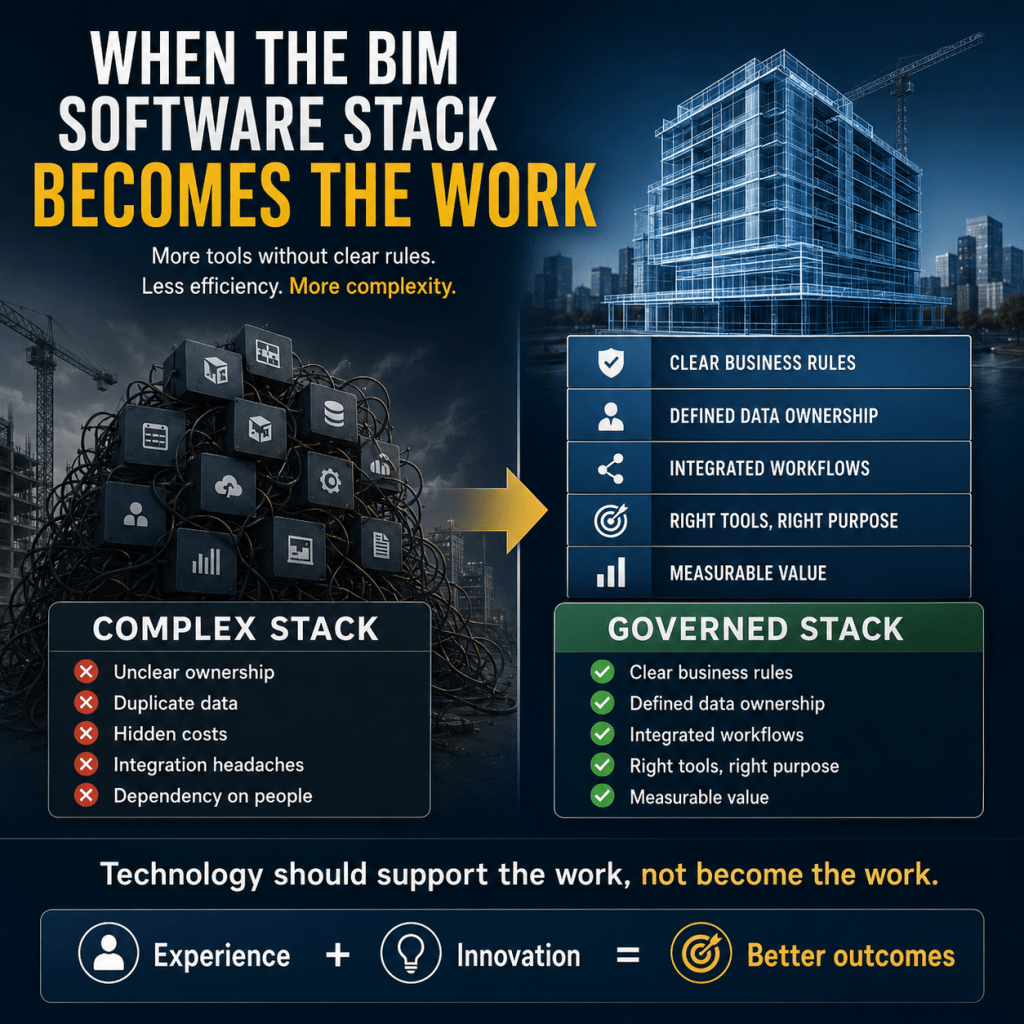
When the BIM Software Stack Becomes the Work
From my experience, BIM efficiency does not usually fail because teams lack software. More often, it fails because the software stack grows faster than the business rules behind it.
Many project teams now work across two, three, four, or more platforms. One tool for authoring. One for coordination. One for issue tracking. One for scheduling. One for asset data. One for dashboards. One for handover. Sometimes each platform has a valid reason to exist. The problem starts when nobody can clearly explain what each platform is responsible for, what data belongs in each system, who maintains it, and how the cost is recovered.
At that point, the stack stops supporting the work.
It becomes the work.
In BIM and construction, this matters because project teams are already under pressure. Margins are tight. Schedules are compressed. Model expectations are increasing. Owners want more usable data. Contractors want faster coordination. Consultants are still required to produce drawings, models, schedules, and responses under fixed scopes and limited time.
Adding more platforms without clear rules does not automatically create efficiency. It can create another layer of administration.
A software stack should answer practical business questions.
Which platform is the source of truth for each data type?
Which system owns the model geometry?
Which system owns asset information?
Which system owns issues, approvals, and evidence?
Which data is required for construction?
Which data is required for handover?
Which data is being duplicated?
Which data is being entered only because the technology allows it?
Which cost is recoverable, and which cost is simply being absorbed by the project team?
Without those answers, software cost is only the visible part of the problem. The hidden cost is usually larger. It includes training, setup, administration, duplicate entry, data clean-up, integration work, quality checks, rework, meetings, support, and the time spent explaining why information in one platform does not match information in another.
This is where I become cautious with the word “ecosystem.”
In technology, the word ecosystem can sound mature and strategic. In nature, an ecosystem is not simple. Ask an ocean biologist. Ecosystems are complex, interdependent, constantly changing, and difficult to control. That may be a useful analogy, but it should also be a warning.
The design and construction industry already operates inside a complex environment. Contracts, disciplines, liability, schedules, standards, field conditions, procurement, and handover requirements are all competing for attention. Adding a complex technology ecosystem on top of an already complex delivery environment can become counterintuitive if the business rules are not defined first.
The same applies to open source.
Open source tools can have value. Commercial platforms can have value. Integrated software can have value. The issue is not whether a tool is open source or commercial. The issue is whether the organization has the governance, support capacity, standards, validation methods, and cost model required to make the tool useful.
Open source is not automatically the answer.
It carries its own risks.
The question is not only whether the tool is free or flexible. The question is who maintains it, who understands it, who supports it when it breaks, and what happens when the person or small group that built the workflow is no longer available.
In that sense, a third party is not always different from a software vendor. Sometimes it can be more risky. A commercial software vendor may increase licensing costs, but there is usually a visible support model, documentation structure, product roadmap, and replacement market. A highly customized open source or third-party solution can become dependent on a narrow group of people who hold the skills, logic, and institutional knowledge behind the system.
That creates a different kind of cost risk.
The license may be low, but the dependency may be high.
If the solution requires rare technical knowledge to maintain, update, validate, or troubleshoot, the organization has not removed cost. It may have moved the cost into a less visible place. In some cases, that cost can become harder to control than a traditional software subscription because the business is now dependent on specialized labour that may not be easy to replace.
This is also where experience needs to be balanced properly.
Younger professionals often bring strong technical fluency, faster adoption, and valuable ideas around automation, data, AI, and modern platforms. That is important. The issue is not age. The issue is whether digital fluency is being mistaken for full project-delivery expertise.
Construction technology is not the same as helping someone set up a phone.
It can feel a bit like watching grandpa at the holidays ask the youngest person in the room to fix his iPhone because he assumes the youngest person is automatically the expert. That may be true for the phone. But when the technology is being used to manage design coordination, construction sequencing, procurement, field installation, liability, handover, and operational data, the answer is not as simple.
Some of the strongest BIM specialists I have seen are field personnel who learned the technology. That matters because field experience brings purpose. On site, actions are not theoretical. They affect sequence, access, installation, labour, safety, cost, and schedule.
Field personnel understand quickly whether a tool is helping the work or adding friction to it.
They are often the true experts in how construction actually gets delivered. They may not need to learn every new software platform just because it appears in the market. In many cases, they are better positioned to vet the tool first and ask the right question: does this create real value for the project, or does it create another layer of work?
That type of judgment is critical.
This becomes even more important on hyperscale projects, where the expectation is often to streamline construction processes, accelerate delivery, and reduce friction. In that context, adding more technical complexity without defined ownership can work against the original goal. The stack may look advanced, but the project team may still be spending more time managing the systems than improving the delivery process.
This is also where terms like “Digital Twin” need to be handled carefully.
I am not against the concept. A well-governed digital representation of assets, systems, spaces, and operational data can create value. But the term can also become a theoretical ideal if nobody defines the cost, responsibility, maintenance model, and measurable use case behind it.
A Digital Twin is not created by saying the words. It requires data governance, system ownership, update procedures, integration rules, validation, and long-term funding. Without that, the idea can become another layer of technology language sitting above an already overloaded delivery process.
As the generation gap increases in technology adoption, more terms enter the conversation. Digital Twin. Ecosystem. AI-ready. Smart handover. Connected data. These terms can be useful, but only when they are tied to practical delivery rules. Otherwise, they can make an organization sound advanced while the project team is still manually fixing data between platforms.
In my view, BIM software strategy should be less about collecting platforms and more about controlling flow.
Information should move through the project with a defined purpose. The model should not become a dumping ground. The CDE should not become a storage closet. Dashboards should not become decorative. Asset data should not be requested unless someone knows how it will be checked, maintained, and used.
The basic test is simple.
If a platform does not reduce risk, reduce duplication, improve coordination, support a required deliverable, improve validation, or support a real downstream use case, then its value should be questioned.
If the software stack requires more effort to manage than the process it was meant to improve, then efficiency is already falling.
The best approach is not old experience versus new technology.
It is both.
Innovation needs construction judgement. Construction judgement needs modern technical fluency. BIM software strategy should bring those two perspectives together before the stack becomes too complex to manage, too expensive to support, or too disconnected from the actual work being delivered.
BIM does not need more disconnected technology language. It needs clear business rules, disciplined data structure, practical standards, and a cost model that reflects the real effort required to produce, check, maintain, and reuse information.
Technology can support better delivery.
But only when the stack is governed.
Otherwise, the software stack becomes another project inside the project.
AI-Assisted Writing Note
This article reflects my practitioner perspective, professional experience, and original ideas. AI tools were used to help refine wording, structure, and presentation, but the opinions, interpretation, and perspective remain my own.
Steven Spry
BIM Specialist | BIMxcel Inc.
 bimxcel