
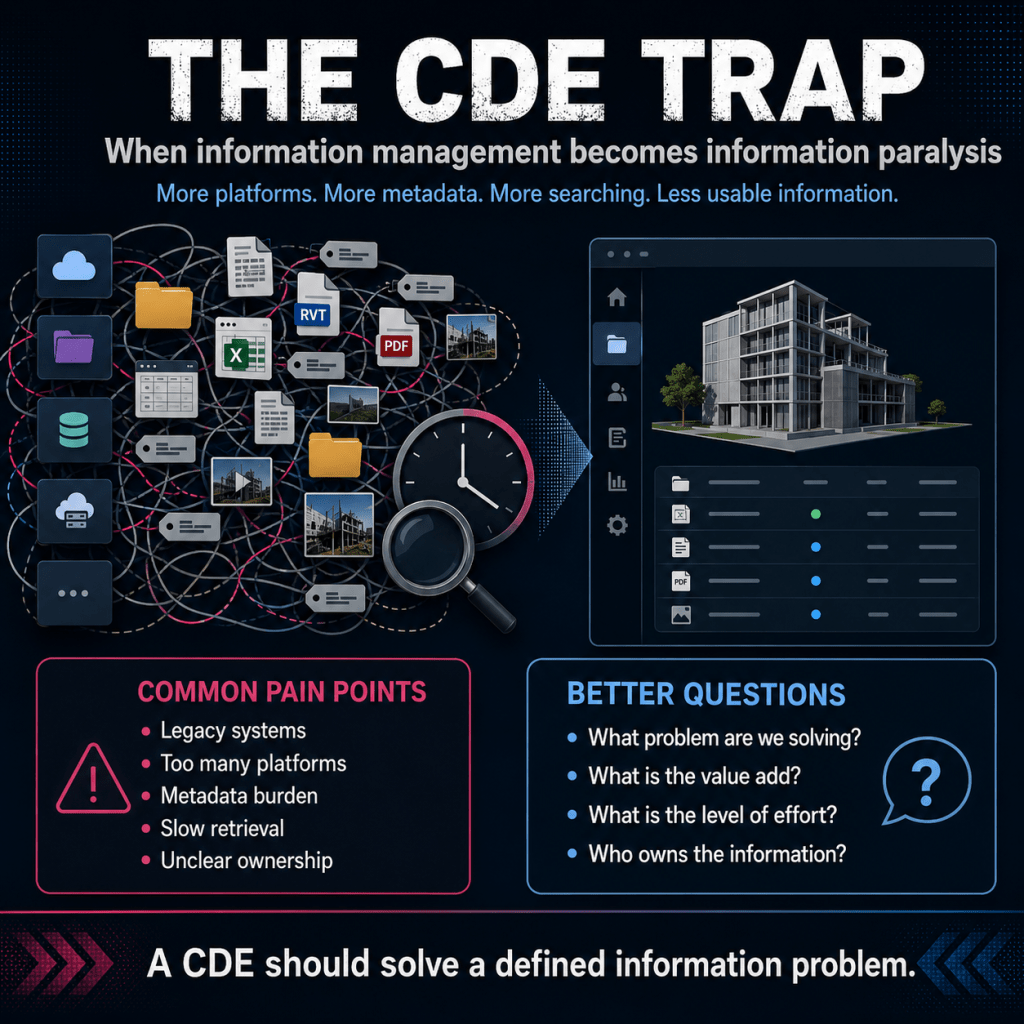
When Information Management Becomes Information Paralysis
From my point of view, the Common Data Environment is one of the most misunderstood topics in BIM information management.
The concept is strong. The intent makes sense. Project and asset information should be collected, managed, shared, reviewed, approved, published, archived, and made available through a controlled process.
The problem starts when the industry turns that concept into a simple software question.
Which platform is the CDE?
That may be the wrong first question.
The better question is this:
What information problem are we trying to solve, and what level of effort is required to solve it properly?
A CDE is not automatically one platform. It is not automatically a cloud folder. It is not automatically a project portal. It is not automatically a model server. It is not automatically a document management system. It can involve all of those things, but that is exactly where the complexity begins.
Most organizations do not start from zero.
They already have information spread across project platforms, content management systems, document management systems, estimating tools, finance systems, CMMS platforms, GIS, SharePoint sites, network drives, email, PDF markups, spreadsheets, model servers, inspection platforms, field applications, procurement records, and legacy folder structures.
So when a CDE is introduced, the question is not simply whether a new platform can store the information.
Most platforms can store information.
The real question is whether the information can be found, trusted, validated, reused, maintained, and funded without creating more work than the value it returns.
That is the part that is often missed.
Every major platform wants to be the one solution. Some vendors position their product as the central environment for project information. Others promote APIs and integrations. Others suggest the system can be configured into whatever the organization wants.
That sounds flexible.
It can also create confusion.
From my point of view, when someone says, “You can make it whatever you want,” there is a risk that the organization starts designing workflows before it fully understands the problem. In a rushed construction environment, teams do not always have enough time to think through long-term information management. Approval steps get added because the platform allows it. Metadata fields get created because the platform allows it. Systems get connected because the platform allows it. Dashboards get built because the platform allows it.
In my opinion, this is where the workflow can start to become over-engineered.
The CDE is at risk of becoming a bottleneck.
The platform can be powerful, but the process can become slower, less clear, and harder to maintain.
From my experience, this is where the CDE can become the complexity it was supposed to solve.
Legacy systems make this even more important.
A CDE implementation can be a full business transformation, not just a software deployment. During project delivery, information may need to move through design models, drawings, specifications, RFIs, submittals, schedules, cost records, site photos, field reports, approvals, construction records, and handover packages. After delivery, the owner may need asset data, warranties, inspection records, maintenance manuals, commissioning information, operational records, and long-term retention.
Those two worlds do not always use the same systems.
A project platform may support coordination very well, but it may not be the system used by operations. A CMMS may be the operational home for asset maintenance, but it may not manage design models or construction records well. A document management system may control official records, but it may not manage model-based information properly. A content management system may store files, but that does not mean the information is structured, searchable, validated, or usable.
This is where disruption can happen.
If everything is forced into one new platform, existing business processes can be affected. If everything remains in legacy systems, the organization can continue with a fragmented information environment. If everything is integrated too quickly, the organization can create technical dependencies that no one fully owns.
That is why a fit-gap assessment should happen before the CDE becomes a platform decision.
What is already being used?
What is working?
What is failing?
Which system owns which information?
Which information must move?
Which information should stay where it is?
Which information needs to be searchable?
Which information needs to be auditable?
Which information needs to support operations after delivery?
Which workflows are worth changing?
Which workflows should not be disrupted?
Who funds the transition?
Who maintains the information after migration?
Who owns the process after project delivery?
Without that assessment, the organization can fund a transformation without proving the value of the transformation.
A CDE should not be implemented just so the organization can say it has a CDE. It should be considered because there is a clear value add, a defined information problem, a realistic funding model, and an agreed operating model.
The cost is not only software.
The cost is time.
Time to classify information.
Time to apply metadata.
Time to validate information.
Time to manage permissions.
Time to review and approve information.
Time to correct errors.
Time to train users.
Time to support integrations.
Time to maintain the information after project delivery.
If that time is not planned and funded, the cost does not disappear. It moves into project teams, document controllers, BIM teams, IT support, asset managers, and operations staff.
A common example is project photos.
In concept, putting site photos into a CDE sounds useful. Photos can support progress records, quality checks, installation evidence, inspections, claims, coordination, and handover. But in reality, photos only become valuable if they are findable.
From my experience, project photos are often downloaded into an information container because there is no time or automation to classify them properly in the field. Someone is leaving site, uploading the photos, and is then expected to fill in the metadata, attributes, descriptions, locations, dates, systems, trades, rooms, issues, and asset references that would make those photos searchable and reusable.
That is not a small task.
I have seen projects where thousands of photos were placed in a project environment and the answer became, “All the photos are in the CDE.”
That sounds organized until it takes days to find the one photo that matters.
In concept, the information exists.
In reality, it is unusable without time.
That is the CDE trap.
Information management does not happen because information was uploaded. It happens because the information was structured, described, governed, validated, and maintained at the right level of effort.
A CDE can also create the illusion that more information is always better.
It is not.
Too much unmanaged information can be just as damaging as missing information. The more files, photos, models, spreadsheets, reports, forms, and records that are collected without a clear purpose, the harder it becomes to separate useful information from noise.
This is not just “junk in, junk out.”
It can become junk in, paralysis out.
The organization has information, but cannot use it in time. The project team has records, but cannot find them quickly. The owner has handover data, but cannot trust it. The operations team receives information, but cannot integrate it into the systems they actually use.
That is not effective information management.
That is a more expensive data dumping ground.
The CDE conversation needs to shift from platform-first thinking to value-first thinking.
Before deploying a CDE, an organization should ask what problem is being solved.
Is the problem version control?
Is it document approval?
Is it model coordination?
Is it asset handover?
Is it field evidence?
Is it audit trail?
Is it operational readiness?
Is it records retention?
Is it data validation?
Is it searchability?
Is it reducing duplicate systems?
Each problem can require a different solution, a different level of effort, and a different operating model.
A practical CDE strategy may not start with an enterprise-wide transformation. It could start with a scoped CDE approach: one project, one information exchange, one approval workflow, one asset class, one handover package, or one operational use case.
That makes the CDE more obtainable.
Trying to solve every information-management problem at once can turn the CDE into another complex system sitting on top of already complex systems.
From my point of view, the real question is not whether a CDE is good or bad.
The real question is whether the organization understands the level of effort required to make it work.
A CDE should reduce information confusion.
If it creates more systems, more handoffs, more administrators, more metadata burden, more unclear ownership, and more time spent searching, then the organization may not be solving the problem.
It may be formalizing the confusion.
In theory, the information is there.
In practice, no one can find it in time.
And in construction, time is usually the point.
Reference note: This article reflects my interpretation of ISO 19650-1:2018 concepts related to Common Data Environment workflow, CDE solutions, information containers, metadata, information states, information management, and project-to-asset information transfer. It is not a reproduction of the standard.
AI-Assisted Writing Note
This article reflects my practitioner perspective, professional experience, and original ideas. AI tools were used to help refine wording, structure, and presentation, but the opinions, interpretation, and perspective remain my own.
Steven Spry
BIM Specialist | BIMxcel Inc.
 bimxcel