
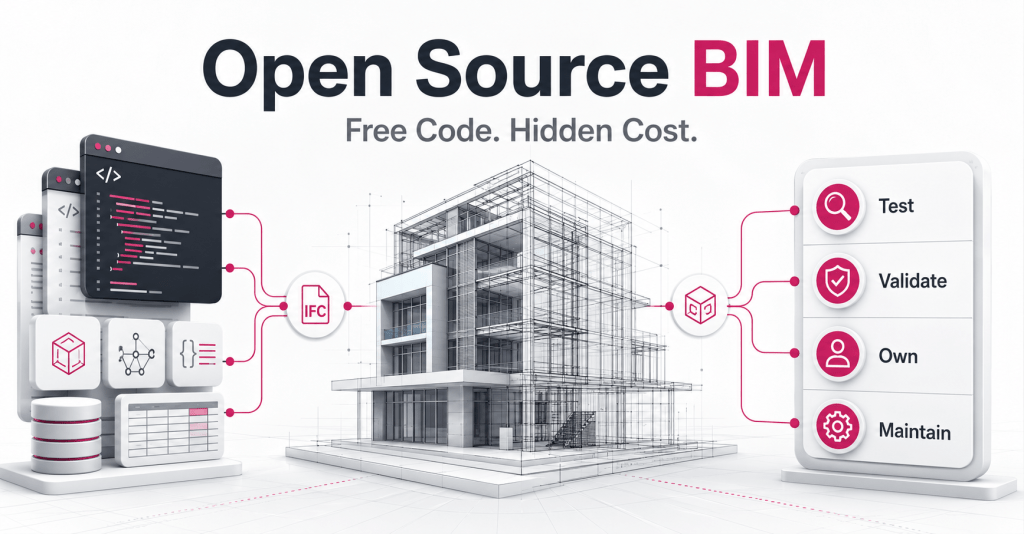
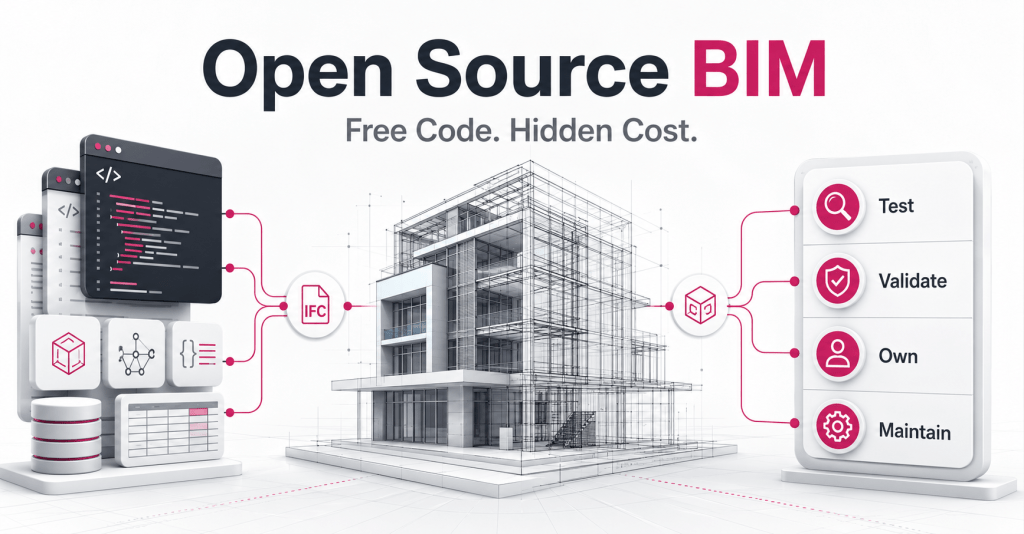
From my point of view, open source has a legitimate place in BIM.
It can be valuable in academic work, research, proof-of-concept development, automation testing, interoperability experiments, and rapid prototyping. It can help teams spin up ideas quickly and test whether a workflow has value before investing in a full commercial solution.
That part makes sense.
The risk starts when open source is presented as an enterprise replacement for commercial BIM platforms without the same level of discussion around support, security, licensing, release control, documentation, maintenance, and business continuity.
Open source can reduce licensing pressure.
It does not remove responsibility.
It moves responsibility somewhere else.
Open source is not the same as open standards
One of the biggest points of confusion in BIM is the difference between open source and open standards.
Open source is about software licensing. In general terms, it means the software can be used, modified, and shared under the terms of an open-source license. That does not automatically mean the software is enterprise-ready, supported, secure, documented, or suitable for production delivery.
Open standards are different. They are agreed technical specifications that support consistent information exchange and interpretation between systems.
In the BIM world, IFC is a good example of an open standard. Its purpose is not to make every software platform open source. Its purpose is to support vendor-neutral exchange of built asset information.
That distinction matters.
An open-source tool does not automatically produce reliable BIM data.
A proprietary platform can still support an open standard.
The real question is not whether the tool is open source.
The real question is whether the information it produces is trustworthy, testable, maintainable, and interoperable.
Open standards should not become shortcuts
One area where this becomes especially important in BIM is IFC.
IFC is an open standard. It exists to support vendor-neutral exchange of built asset information and to reduce dependency on one proprietary software environment. That purpose is important.
But open access to a standard is not the same as permission to treat the standard casually.
From my point of view, there is a risk when open-source tools are used to shortcut the intended discipline behind standards-based exchange. IFC should not be treated only as a file format to manipulate until it appears to work. It is part of a broader interoperability process that includes information requirements, exchange purpose, model view definitions, validation, testing, and agreed implementation.
The value of IFC is not only that it is open.
The value is that it can support predictable exchange when the exchange is defined, tested, and understood.
That matters because the built environment already addressed part of the vendor-lock-in problem through open standards. IFC was created to support exchange between different software environments without requiring every organization to use the same proprietary platform.
If more interoperability is needed, the answer should not be to casually modify the process until a tool appears to pass a local need.
The better answer is to document the exchange requirement, test the outcome, validate the information, and make sure the workflow can be repeated by others.
Otherwise, the organization may think it is improving interoperability, while actually creating a custom dependency that only one person or one toolchain understands.
That is counterintuitive.
Open standards are meant to reduce dependency.
If unmanaged open-source workflows create custom IFC handling that cannot be tested, repeated, certified, or trusted across other systems, then the project may be creating a new dependency under the appearance of openness.
In BIM, interoperability should not be based on a clever workaround.
It should be based on a defined exchange, a tested process, and information that can be trusted after it leaves the authoring platform.
Open source can help test and improve interoperability, but it should not become a shortcut around the discipline required by open standards.
Community-driven does not mean automatically governed
A common argument for open source is that the community watches the code.
That can be true.
It can also be incomplete.
When someone says open source is secure because it is community-driven, the next question should be practical.
Which community?
Which maintainers?
Which review process?
Which vulnerability disclosure process?
Which update cycle?
Which downstream users are notified?
Who confirms the organization actually patched the issue?
Who owns the risk if the tool is used in production BIM delivery?
Open source can benefit from transparency and broad review, but visibility is not the same as governance. A public codebase does not automatically mean that someone is actively maintaining it, testing it against your BIM use case, validating your outputs, checking your licenses, or supporting your project team during a deadline.
In enterprise BIM, security is not only a software issue.
It is also a delivery issue.
If an open-source tool affects model data, schedules, parameters, classifications, IFC export, COBie-style data, asset information, or handover requirements, then it is part of the production system.
That means it needs production-level governance.
Are we shifting away from vendors, or just shifting the dependency?
From my point of view, part of the open-source conversation in BIM is really a vendor conversation.
Commercial vendors have their own issues. Licensing costs rise. Product roadmaps may not match project needs. Some platforms can create dependency, and organizations can feel trapped inside a software ecosystem.
Those concerns are real.
But the answer is not always to assume vendors have no value.
In high-paced design and construction projects, vendor-controlled software can provide scheduled releases, documentation, testing, support channels, training material, compatibility planning, and a known deployment model. That does not make the software perfect, but it does create a level of predictability that project teams often rely on.
So the cost conversation needs to be broader than “commercial software costs money and open source is free.”
A better question is this:
Are we trying to reduce cost by replacing the software, or are we trying to increase productivity by cleaning up the process around the software we already have?
In many cases, the larger opportunity may not be replacing the platform. It may be improving standards, templates, parameters, model setup, QA/QC, naming, automation, training, and data validation so the existing software produces more value with less waste.
I have used open source to create specialist tools for Revit, solve a specific issue, test a workflow, and then delete the tool the same day after the problem was resolved. That is a valid use case. Open source can be excellent for short-cycle problem solving, prototyping, and targeted automation.
But using open source as the standard production method for enterprise BIM delivery is a different question.
That requires governance.
How many failure points are introduced when open-source tools become part of a standards-based project?
Who maintains the tool?
Who tests it after software updates?
Who checks the output?
Who validates the model data?
Who confirms the IFC exchange still works?
Who reviews licensing?
Who supports users during deadlines?
Who documents the workflow?
Who owns the risk if the tool fails during production?
That does not mean open source should be avoided.
It means open source should be treated as part of the production system when it affects production deliverables.
In BIM, the question is not only whether the tool works.
The question is whether the workflow can be trusted under project pressure.
Vendor lock-in versus specialist lock-in
Commercial software can create vendor lock-in.
Open source can create specialist lock-in.
The difference is not always cost. The difference is where the dependency sits.
With a vendor, the organization may depend on licensing, support agreements, product roadmaps, release schedules, and platform decisions.
With open source, the organization may depend on a narrow group of specialists who understand the codebase, dependencies, deployment process, integrations, and custom workflow logic.
That is not automatically better or worse.
It is a different risk profile.
If a third party is required to configure, secure, maintain, patch, document, and support the open-source solution, the organization may not have removed vendor dependency.
It may have replaced one dependency with another.
That third-party support can be valuable, but it should be priced and governed honestly.
If the tool is free but the knowledge to maintain it is rare, the organization has not eliminated cost.
It has moved cost into specialized labour.
Are we creating new silos?
From my point of view, open source can sometimes create a different kind of silo.
The original intent may be flexibility. A team wants to move faster, solve a specific problem, avoid a licensing constraint, or create a custom workflow that commercial tools do not support well. That can be useful.
The risk begins when each expert group starts building its own toolset around different open-source libraries, coding languages, repositories, dependencies, data structures, and development methods.
The BIM automation specialist may build one workflow.
The data analyst may build another.
The GIS specialist may use another stack.
The asset management team may rely on a different structure.
The software developer may use a different source, package, or framework.
The field technology group may use another platform entirely.
Each group may be solving a real problem, but the organization can end up with several technical silos that are harder to manage than the vendor ecosystem it was trying to avoid.
This is where open source can become fragmented.
Not because the tools are bad.
Because the governance is missing.
In BIM, this matters because the output is not only code. The output can affect model data, parameters, schedules, classification, IFC exchange, COBie-style data, asset registers, validation rules, and handover information.
If each group builds its own solution without an agreed information standard, the organization may gain local speed but lose enterprise consistency.
That is not always visible at the beginning.
The first tool works.
The first script solves the problem.
The first automation saves time.
Then a second team builds a different version.
Then a third team modifies it.
Then no one knows which tool is current, which library is approved, which output is trusted, which workflow is supported, or who owns the risk when something fails.
That is how a productivity tool can become an information-management problem.
Open source can support innovation, but enterprise BIM still needs controlled standards, approved libraries, documented workflows, version control, testing, and ownership.
Otherwise, the organization may not be escaping silos.
It may be building new ones.
Open source can remove vendor lock-in, but without governance it can create expert lock-in, workflow lock-in, and data-silo lock-in.
Academic value versus enterprise dependency
Open source also needs to be discussed with respect for the academic and research communities that often create important tools, methods, and prototypes.
From my point of view, academia has real value in the BIM technology landscape. Research environments can test ideas, challenge commercial assumptions, explore interoperability, and move faster than enterprise procurement cycles. That matters.
The issue is not academic contribution.
The issue is enterprise dependency.
A research prototype, student-built tool, or community-maintained library can be valuable, but that does not automatically make it enterprise-ready. Production BIM delivery needs support, documentation, security review, licensing clarity, release control, testing, user training, lifecycle maintenance, and accountability.
If an organization benefits from academic or community open-source work, it should also ask how that work is sustained.
Who maintains it?
Who funds it?
Who reviews it?
Who responds when it breaks?
Who keeps it aligned with future software releases?
Who owns the risk when it becomes part of a production workflow?
That is not a criticism of academia.
It is a recognition that enterprise use requires enterprise responsibility.
Is open source free?
Open source can be free to download.
That does not mean it is free to operate.
The hidden cost can include internal staff time, third-party support, security monitoring, license compliance, documentation, testing, deployment, training, customization, integration, data validation, backup and recovery, and business continuity planning.
This matters in BIM because the work often happens under project pressure.
A tool that works in a controlled test environment may create risk when used across multiple models, teams, disciplines, offices, or project stages.
A tool that works today may need adjustment after the next Revit update, IFC schema update, Python package update, API change, security patch, operating system change, or internal IT policy change.
Fast release cycles can be excellent for innovation.
They can be difficult for enterprise stability.
That does not mean slow is better.
It means release control matters.
A practical way to use open source in BIM
The better question is not whether open source is good or bad.
The better question is where it fits.
Open source can be highly valuable for:
Research.
Education.
Prototype development.
Interoperability testing.
Targeted automation.
Validation tools.
Internal utilities.
Proof-of-concept workflows.
Short-cycle problem solving.
But before it becomes part of enterprise BIM production, the organization should define the operating model.
That should include:
A license review.
A security review.
A support model.
A release strategy.
A testing process.
A rollback plan.
Documentation.
Ownership.
Training.
Data validation.
Business continuity.
A cost model.
A decision on whether the tool is experimental, project-specific, supported, or enterprise-approved.
That distinction matters.
Not every tool needs to become enterprise infrastructure.
Some tools are temporary.
Some are experimental.
Some solve one problem and should then be retired.
Some deserve to become supported internal products.
The problem is when those categories are not defined.
The real BIM question
In BIM, open source should not be judged only by the cost of the code.
It should be judged by the reliability of the information it helps produce.
Does it improve data quality?
Does it support open standards?
Does it reduce duplication?
Does it improve validation?
Does it make exchange more reliable?
Does it reduce project risk?
Does it support repeatable workflows?
Does it have an owner?
Can the output be trusted?
If the answer is unclear, the organization may not be reducing cost.
It may be creating a new class of unmanaged dependency.
Open source is not the enemy of BIM.
Unmanaged dependency is.
The goal should not be open source for its own sake. The goal should be better information, lower risk, clearer ownership, and more reliable exchange.
In BIM, open standards and open source can both have value.
But they are not the same thing, and neither one removes the need for governance.
References
[1] Open Source Initiative, The Open Source Definition.
[2] buildingSMART International, Industry Foundation Classes (IFC).
[3] buildingSMART Technical, IFC Technical Documentation / ISO 16739-1:2024.
[4] buildingSMART Technical, Model View Definitions.
[5] Open Source Security Foundation, Software Supply Chain initiatives.
Reference note
This article reflects my own interpretation of publicly available open-source, open-standard, and BIM interoperability concepts. It is not a reproduction of any standard, vendor material, proprietary implementation, academic work, or third-party framework. No diagrams, tables, definitions, source code, or proprietary implementation details have been reproduced.
AI-Assisted Writing Note
This article reflects my practitioner perspective, professional experience, and original ideas. AI tools were used to help refine wording, structure, and presentation, but the opinions, interpretation, and perspective remain my own.
Steven Spry
BIM Specialist | BIMxcel Inc.
 bimxcel