
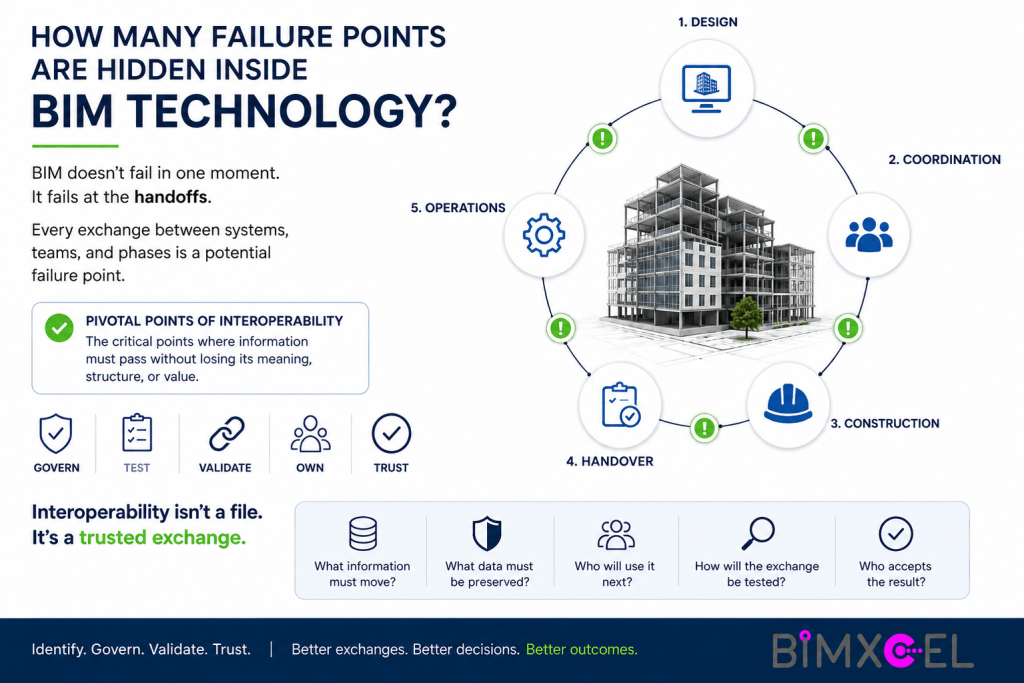
From my point of view, BIM technology does not usually fail at one dramatic moment.
It fails at the handoffs.
A model is exported. A parameter is renamed. A schedule is trusted without validation. An IFC file opens, but the data is incomplete. A handover package is accepted because it exists, not because operations can use it.
That is where BIM starts to lose value.
The industry often talks about software as if the platform itself solves the problem. But BIM delivery is usually a chain of people, systems, files, exports, imports, approvals, data structures, and assumptions.
Every handoff in that chain can become a failure point.
The better question is not only:
Which software are we using?
The better question is:
Where are the pivotal points of interoperability, and are they governed?
What is a pivotal point of interoperability?
I am using “pivotal point of interoperability” as a practical BIM lens, borrowed from public smart-city and digital-systems interoperability work.
In simple terms, it is the point where information must pass from one system, team, phase, or use case to another without losing its meaning, structure, or value.
It is not just a file transfer.
It is a trust point.
At that point, information either remains useful, or it starts to degrade.
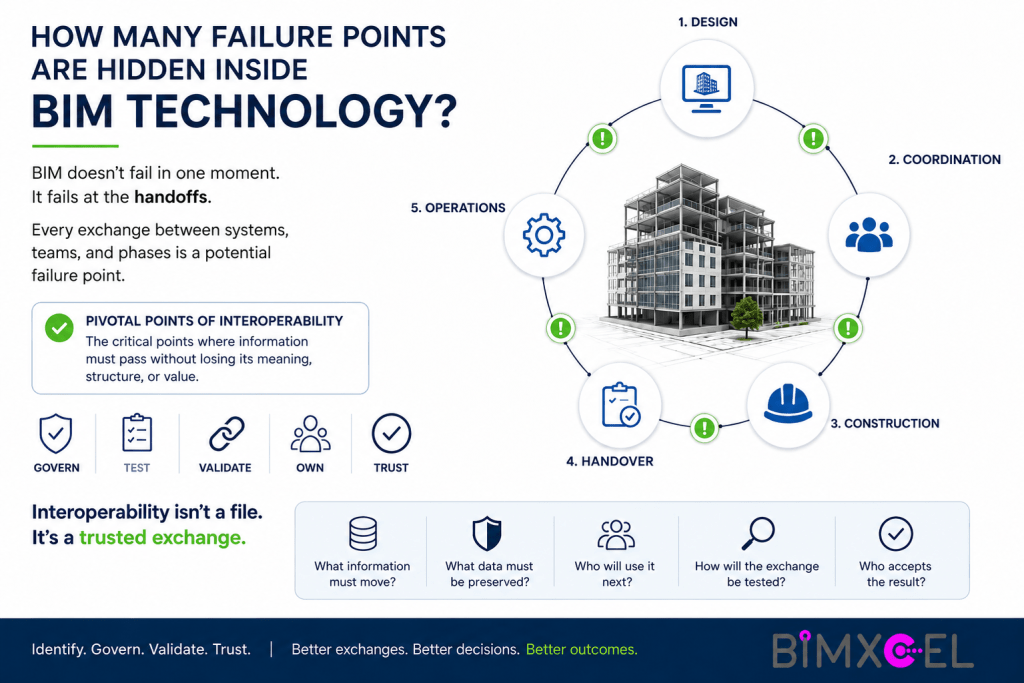
In BIM, this can happen when design information moves into coordination, when coordination information moves into construction, when construction records move into handover, or when handover data moves into operations.
These are the moments where interoperability becomes real.
A short origin note
The term “Pivotal Point of Interoperability” appears in public smart-city and IoT interoperability work, including NIST smart-city framework activity. The basic idea is that not every system needs to be standardized in the same way. Instead, attention is placed on the key interface points where systems must connect consistently enough to exchange useful information.
A related idea appears in Minimal Interoperability Mechanisms, often discussed in smart-city and digital-service contexts. The focus is on the minimum practical mechanisms needed for systems, services, and data to work together.
I am not presenting PPI or MIMs as BIM-specific standards.
I am applying the concept to BIM because the problem is similar.
Construction and asset management already involve too many systems to assume one platform will solve everything. The value is not in pretending everything can be unified. The value is in knowing where information crosses a boundary, what must be preserved, and how the exchange will be tested.
Where BIM failure points show up
Common BIM failure points include:
Design model to coordination model.
Coordination model to issue platform.
Model data to drawings, schedules, and IFC.
Field capture to structured records.
Project handover to CMMS or operations.
Each of these points can fail in a different way.
Some are geometry failures.
Some are data failures.
Some are naming failures.
Some are classification failures.
Some are contractual or operational failures.
That is why “provide a BIM model” is not enough.
A better requirement defines five things:
What information must move?
What data must be preserved?
What system or team will use it next?
How will the exchange be tested?
Who accepts the result?
Without those answers, interoperability becomes a hope, not a process.
Technology adds interfaces
Technology can reduce risk, but it also adds interfaces.
Every new platform introduces another point where information must be mapped, translated, validated, secured, maintained, and understood.
That is not an argument against technology.
It is an argument for governance.
If a BIM workflow uses authoring tools, coordination platforms, CDEs, IFC, Excel, dashboards, GIS, CMMS, field capture tools, and owner systems, the failure risk is not only inside the software.
The failure risk is between the software.
That is where pivotal points of interoperability matter.
Open standards help, but they do not remove failure points
Open standards are important.
IFC can help reduce dependency on one proprietary platform and support exchange between different systems.
But an open standard is not a magic export button.
The exchange still needs to be defined, tested, and validated.
If the authoring model is poorly structured, the export can carry poor structure.
If the wrong exchange view is used, information can be missing.
If the data is not mapped, the receiving system may not understand it.
If the receiving system interprets information differently, the exchange may technically succeed while operationally failing.
The better question is not:
Did the file open?
The better question is:
Did the information survive the exchange with its meaning intact?
A simple example
A design team creates a Revit model.
The model is coordinated.
Issues are tracked.
The model is exported to IFC.
Schedules are exported.
Asset data is prepared for handover.
The owner expects the information to support operations.
That sounds like a normal digital workflow.
But there are several failure points inside it.
Does the model contain the required asset data?
Do the parameters match the required structure?
Does the IFC export carry the required properties?
Does the handover data match the installed asset?
Can the receiving operational system use the information?
Each answer is a possible failure point.
The issue is not that BIM technology is weak.
The issue is that each exchange must be treated as a governed moment.
Why owners should care
Owners usually inherit the long-term consequences of poor interoperability.
A project can use BIM, a CDE, IFC, dashboards, field tools, and handover files, and still leave the owner with information that is hard to find, hard to trust, or hard to use.
That is why owners should not only ask for technology.
They should ask for controlled information exchanges.
A controlled exchange should make five things clear:
Where does information cross a boundary?
What information must survive?
Who owns the exchange?
How is it tested?
What downstream process depends on it?
Without those answers, interoperability becomes a hope, not a process.
The real question
The real question is not how many technologies a project uses.
The real question is how many ungoverned failure points the project has created between them.
A file transfer is not interoperability.
A model export is not validation.
A dashboard is not governance.
A handover package is not operational readiness.
The pivotal point of interoperability is where those assumptions should be tested.
If the information survives that point, BIM has a chance to create downstream value.
If it does not, the project has only moved the problem from one system to another.
Reference note
This article uses “pivotal point of interoperability” as a practical BIM interpretation of a concept found in public smart-city and digital interoperability discussions, including NIST smart-city framework activity. It also references Minimal Interoperability Mechanisms only as a related public interoperability concept. It does not present PPI or MIMs as BIM-specific standards, nor does it reproduce any standard, vendor framework, or proprietary method.
 bimxcel