
How Much Technology Can We Put Into a Hammer?
At some point, the question has to be asked: how much technology can we put into a hammer before it stops being useful?
This is how I sometimes look at BIM, digital delivery, automation, AI, dashboards, CDEs, digital twins, and the growing number of platforms being pushed into construction and facility management.
A hammer is simple. It has a purpose. It transfers force to drive a nail. The value is not in how complicated the hammer becomes. The value is in whether it does the job better, safer, faster, and with less waste.
But in technology, the industry often moves in the opposite direction. Instead of asking what problem is being solved, another layer gets added. Another platform. Another dashboard. Another integration. Another data requirement. Another workflow. Another subscription. Another innovation that someone now has to manage, train, validate, maintain, and explain.
The result is not always progress.
Sometimes it is just a heavier hammer.
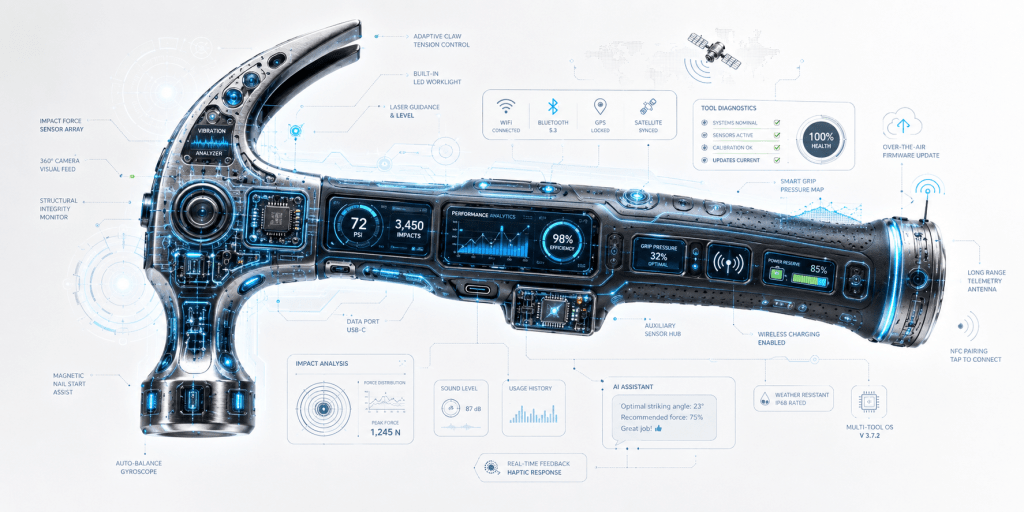
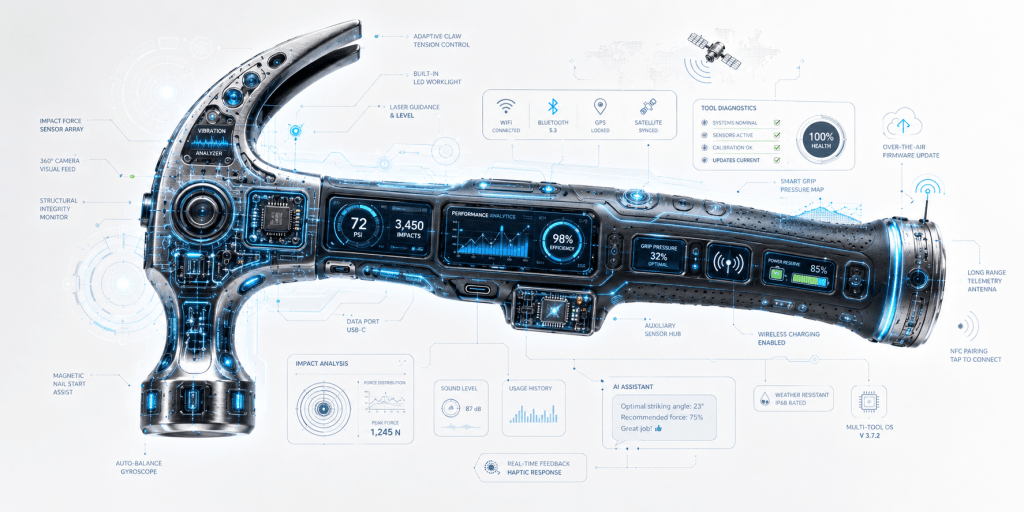
A silly example would be the “smart hammer.”
At first, someone adds a pressure indicator to the handle so the user can see how much force was applied to the nail. That sounds useful.
Then someone adds Bluetooth, so the hammer can send the strike data to a mobile app.
Then someone adds a dashboard, so the supervisor can review hammer productivity by user, by floor, by room, and by nail type.
Then someone adds GPS tracking, so the hammer location can be monitored in real time.
Then someone adds a subscription model, because the pressure data needs cloud storage.
Then someone adds AI, so the hammer can recommend a better swing angle.
Then someone adds a compliance report, so every nail can be logged, timestamped, categorized, and archived for handover.
At some point, the hammer may still work, but the simple task has become a managed technology ecosystem.
That is the point.
The pressure indicator may have value if the problem is quality control, training, safety, or repeatability. But if the job is simply to drive a nail, the added technology has to justify the added cost, workflow, training, data management, and maintenance.
Otherwise, the industry has not improved the hammer.
It has created another system around the hammer.
There is also a point where it may stop being a hammer.
A hammer is understood because its purpose is clear. It is held, swung, and used to drive or remove something. The user knows what problem it solves.
But if the hammer now needs a login, calibration, a data standard, a software update, a dashboard, a cloud connection, a cybersecurity review, and a monthly report before it can be trusted, then the tool has changed.
It may still look like a hammer.
But operationally, it has become a system.
That distinction matters in BIM.
A model used to produce drawings is one thing. A model expected to support coordination, estimating, scheduling, procurement, handover, operations, AI, digital twins, and long-term asset management is no longer just a production model. It has become an information system.
That does not make it wrong. But it does mean the responsibility has changed.
The scope has changed.
The cost has changed.
The governance has changed.
And the people managing it need to understand that change before the technology is added.
This is where many digital strategies become unclear. The industry keeps calling it the same hammer, while quietly asking it to become a measuring device, a reporting tool, a compliance record, a data source, and an operational asset.
In BIM, this shows up everywhere.
A model is created for drawings. Then the same model is expected to support coordination, quantities, scheduling, handover, asset management, facility operations, digital twins, AI readiness, and long-term data reuse. Each new requirement sounds reasonable on its own. But when the purpose, scope, ownership, and data structure are not clearly defined, the model becomes overloaded.
That is where value starts to break down.
Technology should reduce friction. It should not create a second job just to manage the tool that was supposed to make the first job easier.
The real question is not whether a platform is advanced. The real question is whether it improves the decision, the output, or the operational result. If it does not, then it may only be adding complexity.
A smart hammer is only smart if the pressure data solves a real problem. Otherwise, it is just a hammer with homework.
The same applies to BIM and digital workflows.
Before adding more technology, there should be a simple test:
What problem does it solve?
Who owns the output?
Who maintains the data?
Can the information be checked?
Can it be reused?
Does it reduce effort, or does it move the effort somewhere else?
From my experience, this is where many technology strategies fail. They start with the tool, not the outcome. They assume that more technology equals more control. But control does not come from the number of systems in use. Control comes from clear requirements, structured data, repeatable workflows, and measurable outputs.
There is nothing wrong with advanced technology. Automation, AI, structured BIM data, digital handover, and lifecycle information management can create real value. But only when the foundation is clean.
If the parameters are inconsistent, the schedules are not trusted, the naming is unclear, and the data cannot be validated, then adding another technology layer does not fix the problem. It usually amplifies it.
That is the hammer problem.
The industry keeps trying to improve the tool before confirming that the work process is understood.
A better approach is not to reject technology. It is to make technology earn its place.
Use the few tools that produce the required outcome. Master them. Standardize them. Measure the value. Then add technology only where it solves a real problem or creates a clear return.
For BIM, that means knowing when the model is for documentation, when it is for coordination, when it is for handover, and when it is expected to support operations. Those are not always the same requirements, and they should not be treated as if they are.
It stops being a hammer when the technology around it becomes more important than the task it was built to perform.
At that point, the question is no longer, “Can the hammer do more?”
The better question is, “Are we still using a hammer, or have we built a system that now needs proper ownership, standards, maintenance, and accountability?”
The industry does not need a smarter hammer just because one can be built.
It needs better decisions about when the hammer is the right tool in the first place.
AI-Assisted Writing Note
This article reflects my practitioner perspective, professional experience, and original ideas. AI tools were used to help refine wording, structure, and presentation, but the opinions, interpretation, and perspective remain my own.
 bimxcel