
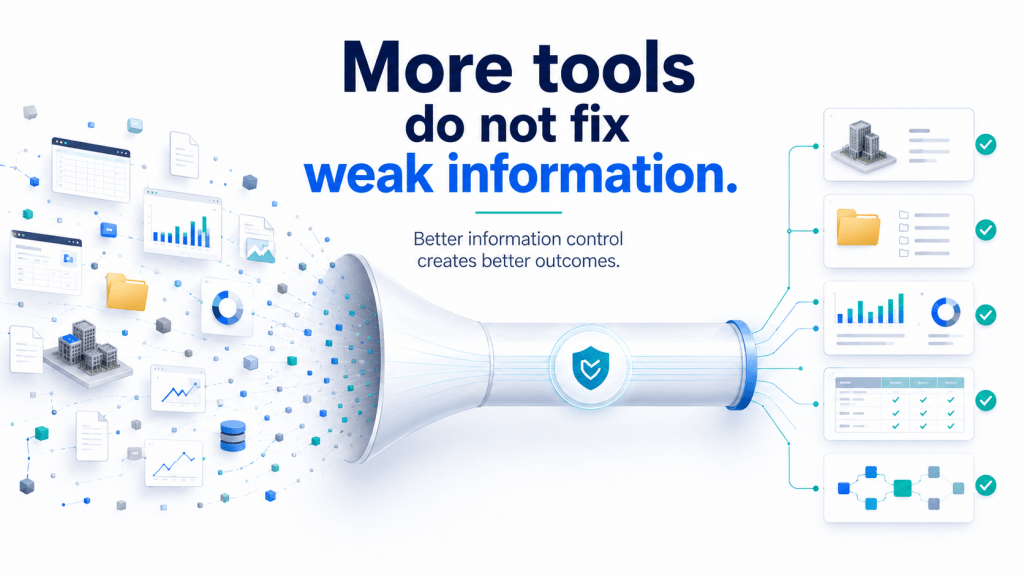
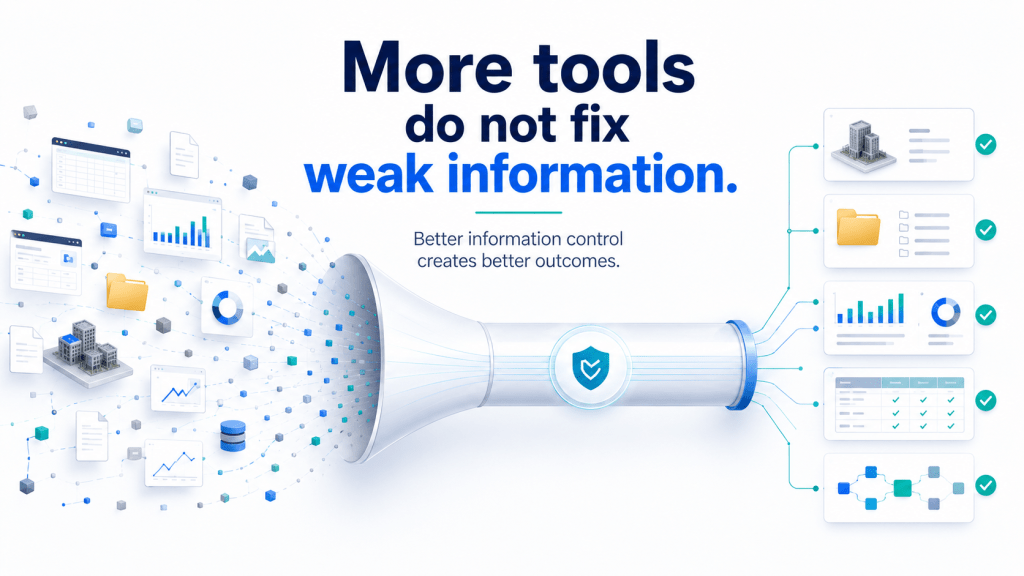
The construction and asset management industry is not short on software.
There are more platforms, dashboards, viewers, coordination tools, digital twin environments, AI tools, and data workflows than ever before. Yet many organizations still struggle with the same problems: unreliable model data, unclear handover requirements, duplicated information, disconnected systems, and project information that cannot be reused with confidence.
From my perspective, this is not mainly a technology problem.
It is an information control problem.
The industry often moves quickly toward the next tool before asking a more basic question:
What information is actually required, who owns it, who checks it, and how will it be used after the project is delivered?
That question is where many digital strategies start to break down.
More software does not automatically create better outcomes
Adding another platform can feel like progress. It can create visibility. It can improve collaboration. It can give project teams a better interface.
But if the underlying information is not structured, validated, and governed, the tool only exposes the problem in a different place.
A dashboard does not fix bad data.
A digital twin does not fix unclear asset requirements.
AI does not fix missing parameters.
A common data environment does not automatically make information trustworthy.
These tools can add value, but only when the information foundation is controlled. Without that control, organizations risk building more complexity around information that was never properly defined in the first place.
The real gap is between model production and information management
In many projects, the focus is still on producing models, drawings, schedules, and coordination outputs. That work is important. It supports design and construction. It helps teams communicate.
The issue is that model production and information management are not the same thing.
A model can look complete and still fail as an information asset.
A drawing can be issued and still contain data that is inconsistent, incomplete, or difficult to reuse.
A schedule can be exported and still not support operations, maintenance, lifecycle planning, or downstream analytics.
The question is not only whether a model was produced.
The question is whether the information inside that model can be checked, scheduled, exported, validated, and reused for a defined purpose.
That is where many BIM standards become weak in practice. They may describe naming, file structure, modelling expectations, or coordination procedures, but they do not always define testable information requirements.
A standard that cannot be tested is hard to govern.
Operational value must be defined early
One of the biggest mistakes is waiting until handover to decide what information matters.
By that point, the project team may have already made hundreds of decisions about parameters, classification, naming, model structure, and documentation methods. If those decisions were not tied to operational use, the owner may receive a large volume of information but limited usable value.
This creates a familiar problem.
The project is delivered.
The files are handed over.
The models are archived.
The operations team still has to rebuild, clean, verify, or manually re-enter the information they actually need.
That is not digital transformation. That is delayed information management.
If owners want better asset information, the requirements need to be defined at the beginning. They need to be included in contracts, supported by templates, checked during delivery, and validated before handover.
The information must have a purpose before it has a platform.
The industry needs stronger information discipline
The path forward is not to reject technology. The path forward is to be more disciplined about why technology is being used.
Before adding another tool, organizations should be asking:
What problem does this solve?
What information does it require?
Who is responsible for maintaining that information?
How will the information be checked?
What downstream process will use it?
What value does it create beyond the project team?
If those questions cannot be answered, the platform may become another layer of administration instead of a source of value.
Better information control means stronger requirements, cleaner data structures, clearer accountability, and more testable deliverables. It also means accepting that not every project needs every platform, and not every workflow needs to become more complex.
Sometimes the most valuable improvement is not adding technology.
Sometimes it is removing noise.
The point
The problem is not that the industry lacks technology.
The problem is that technology is often being asked to fix information that was never properly structured.
If the data is inconsistent, the output will be unreliable.
If the requirements are unclear, the handover will be weak.
If the operational purpose is missing, the model becomes another project artifact instead of a long-term asset.
The industry does not need to slow down innovation.
It needs to connect innovation to information value.
That means fewer assumptions, better requirements, testable standards, and a stronger link between project delivery and operational use.
More software will not fix weak information governance.
Better information control will.
AI-Assisted Writing Note
This article reflects my practitioner perspective, professional experience, and original ideas. AI tools were used to help refine wording, structure, and presentation, but the opinions, interpretation, and perspective remain my own.
 bimxcel