
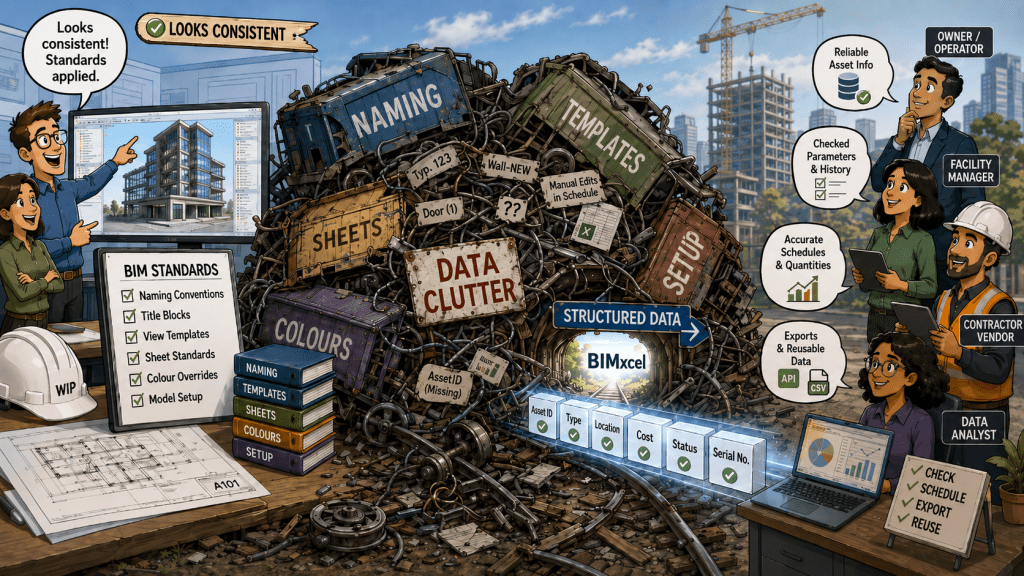
Why BIM Standards Fail Without Structured Data
From my experience, a BIM standard is only useful when the model data can be checked, scheduled, exported, and reused.
Many organizations already have standards in place. They may have naming conventions, title block rules, view templates, sheet standards, folder structures, colour overrides, and model setup instructions. These standards matter. They bring order to production and help teams deliver consistent drawings and models.
However, from my perspective, many standards are built mainly around one organization’s part of the process.
That is where the gap often begins.
A designer’s standard may work well for design production. A contractor’s standard may work well for coordination and installation. A vendor’s standard may support fabrication, procurement, or asset tracking. An owner’s standard may focus more on operations, maintenance, reporting, and long-term asset information.
None of these priorities are wrong. They are just not always aligned.
It is easy to call this a silo problem, but I do not think that is always fair. Designers and consultants are often doing exactly what they are contracted, funded, and liable to do: produce their discipline deliverables, coordinate their scope, meet project milestones, and issue drawings or models that support design and construction.
The problem is that downstream users often need more than that.
Owners, operators, facility managers, vendors, sub-trades, software platforms, and data teams may expect structured information that was never clearly defined, priced, governed, or included in the delivery process. At the same time, asking a designer to restructure internal business rules, Revit templates, parameters, naming conventions, and QA/QC workflows can affect time, cost, liability, and profitability.
From my understanding, that does not mean the downstream need is wrong.
It means the information requirement was not properly integrated into the project delivery model.
This is why I believe BIM standards need to go beyond appearance and internal production rules. A standard should not only explain how an organization models. It should also define what information needs to move forward, who will use it, how it will be checked, and how it can be scheduled, exported, and reused.
A model can look correct and still contain poor data. Equipment may be placed correctly, but may be missing required parameters. Families may look right but use inconsistent naming. Schedules may appear complete but rely on manual edits. Asset data may exist, but not in a form that can be validated or handed over with confidence.
In my opinion, that is not structured data.
That is data clutter.
Better BIM standards do not automatically turn a design model into a full asset information model. However, they can improve the percentage of useful information that moves downstream. Clearer parameters, naming, classification, schedules, families, and model setup can reduce confusion and make the real information gaps easier to identify.
The goal should not be to collect more data for the sake of collecting data.
The goal should be to define the right data for the right purpose.
From my perspective, a strong BIM standard does more than make models look consistent.
It makes information reliable.
Steven Spry
BIM Specialist | Founder, BIMxcel Inc.
AI-assisted editing was used. The ideas, final content, and responsibility are my own.
 bimxcel
Leave a comment